
Was this newsletter forwarded to you? Subscribe here.

Welcome to the Friday news-you-can-use edition of MoneyNerd!
In today’s lineup:
Affordability: The squeeze is on.
The bond market: How it’s affecting mortgage rates.
Smart Money: The skinny on surveillance pricing.
Super El Niño: Is your home ready?
Video: Is a recession coming?
And more!

The affordability squeeze is real

Anna here. Let’s talk about affordability, as in, can you afford groceries? Can you afford gas? Can you afford to have that pain in your neck checked out by a doctor?
Leading up to November’s midterm election, it’s the No. 1 issue candidates all over the U.S. are beating their drums about. Meanwhile, the president has dismissed concerns about affordability as “a political con job.”
Try not to be shocked, but new data verifies that a lot of people are in fact barely getting by (despite the "con job" rhetoric).
A new Georgetown University Center on Poverty and Inequality study (a.k.a. the “Family Economic Well-Being Index”) found that most of us — 70% of Americans, regardless of income — are financially squeezed in at least one area of our lives. That could be housing, food, child care or healthcare costs. It’s not just people with low incomes: Over a quarter of middle-income households say they’re most burdened by housing costs and almost half are stretched thin by healthcare costs. Among those upper-echelon folks, half say their biggest struggle is affording child care.
Check out NerdWallet’s monthly Financial Resilience Index.
As expected, income inequality is still the divide between those who can and cannot afford groceries, gas and medical care, among a host of other expenses. The report shows that those with lower income have more burdens compared to their wealthier counterparts — a “no duh,” statement, for sure, but still accurate. About one in six people reported that they’re juggling three or more financial burdens.
Racial gaps remain stark among those under financial pressure: 80% of Latino Americans and 77% of Black Americans face at least one burden, with roughly 1 in 4 and 1 in 5, respectively, juggling three or more. Compare that to 66% of white Americans and 67% of Asian Americans experiencing any burden, with burden-stacking rates around half that of Black and Latino households.
How you live matters, too: Those who rent get hit harder than homeowners — they’re twice as likely to be carrying three or more financial burdens (27% versus just 12%).
Politicians will argue over whether America has an affordability problem, but it hardly seems debatable. It's an all-too-real stressor for most people, regardless of income, living situation, race or political affiliation.
But maybe the better question isn’t whether Americans can afford things, but how many financial burdens they can bear before something has to give. When the pressure comes from multiple directions, eventually, the center cannot hold.
Need help working through your bills? Try this self-help tool.
The bond market is having a moment. Your mortgage rate is feeling it.

- Abby Doyle, mortgages writer
Mortgage rates are above 7%, and if you’re just skimming headlines, it’s tempting to pin all the blame on the Federal Reserve. But the Fed is only one player in a much bigger picture … and it’s not the villain! (The Fed gets a bad rap for hiking rates, but that’s simply an attempt to pump the brakes on inflation — and eventually bring borrowing costs down.)
My colleague Kate Wood’s fantastic new explainer gets into a bigger driver behind mortgage rates: the bond market.
Bonds are essentially tiny loans that fund someone else’s debt, like the U.S. government (Treasury bonds) or a tech company building a data center (corporate bonds). The whole thing’s worth a read, but here are some highlights:
📈 Mortgage rates move closely with the yield on the 10-year Treasury note, which recently hit its highest point since 2002 — ouch.
🤖 Treasury bonds have long been the go-to safe investment, but they’re not the only option for investors right now. Big tech is borrowing billions to fund AI, offering another place to park money.
🎈 When inflation is high, like it is now, demand for bonds can drop because future interest payments are worth less.
All of this is helping to drive the “bond market selloff” you may have read about — which, in turn, pushes mortgage rates higher.
If anyone can make a bond-market explainer as compelling as scrolling my go-to gossip subreddit, it’s Kate. Where was this gal in my undergrad macroeconomics class?

Smart Money: Yes, you are being surveilled at the grocery store
In the news segment of this week's Smart Money podcast, senior news writer Anna Helhoski speaks with personal finance writer Amanda Barroso about surveillance pricing, where retailers use data from loyalty programs, apps and even how fast you type to set prices based on what they think you’ll be willing to pay. They explain how surveillance pricing works and what shoppers can do to shake up the algorithm.
Watch below.
For the full episode:
Watch or listen on Spotify.
Listen on Apple Podcasts.
Check out more NerdWallet podcasts.
Is your home ready for a super El Niño?

- Elizabeth Aldrich, insurance writer
It wasn’t until wildfire unexpectedly ripped through my mother-in-law’s neighborhood in Spokane, Washington, this summer that I realized it might be time to metaphorically dust off my insurance policies and check my coverage.
As it turns out, I was underinsured — and so are millions of other Americans. With news circulating about this year’s record-breaking super El Niño peaking this winter, I felt an urgent need to warn every homeowner I could: Audit your home insurance policy before it’s too late.
Because if disaster hits and your coverage limits are low and outdated, or your policy excludes the event altogether, you could end up staring down a repair bill you can’t afford. When you’re forced to rebuild your life from the ground up, the last thing you need is a surprise denial or a battle with your insurance company.
I spoke with a consumer advocate and an independent insurance broker to uncover the biggest vulnerabilities in standard home insurance policies. Luckily, coverage gaps can be easy to close once you know where to look. Pull up your policy and follow along with our 10-minute audit guide to make sure you’re properly covered before the damage is done.

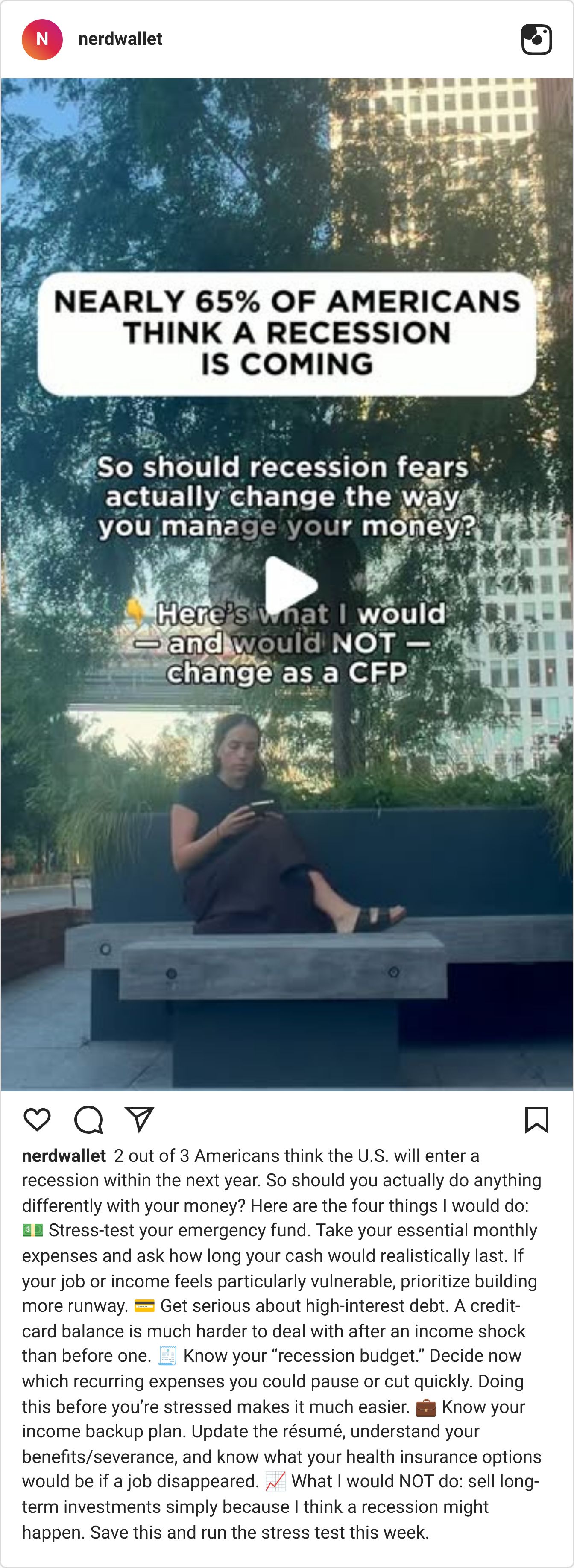
Most Americans think a recession is coming
Two in three Americans think the U.S. will enter a recession within the next year. We never know exactly when a recession will strike, so should you actually do anything differently with your money?

Here’s what else you may have missed this week from NerdWallet:
Suddenly, everyone is delaying their IPOs.
Why crypto has made a comeback this fall.
If an AI agent makes a mistake, can you get your money back?
Three questions you should ask about your financial advisor.
What if pretend shopping could help you spend less?
Elsewhere in money news:
The top 0.1% of Americans control about 15% of the nation’s wealth — some $28 trillion. (The Wall Street Journal) 🔒
The Treasury Department will temporarily auto-enroll children in Trump Accounts. (CNBC)
Mideast oil exports are rebounding — but prices remain high. (The New York Times) 🔒
The Trump administration is removing 760,000 people enrolled in the Affordable Care Act marketplace. (The Guardian)

Here’s what NerdWallet’s news team is tracking in economic news and data for the week of Oct. 5:
We’ll get a look at how consumers are feeling about the economy and their own finances with two studies — the New York Federal Reserve’s Survey of Consumer Expectations for September on Oct. 7 and the initial results of the University of Michigan’s Index of Consumer Sentiment for October.

In Tuesday's edition of MoneyNerd, we’ll chat about:
Prime Day shopping tips. 🛍️
Where to get free tacos. 🌮
Should you use AI for customer service interactions? 🤖
Your MoneyNerd team: Courtney Neidel, Anna Helhoski, Rick VanderKnyff, Lauren Schwahn and Pamela de la Fuente.
Know someone who’d love MoneyNerd? Open and share this unique referral link.
See all of NerdWallet’s newsletters here.
Until next week,
