

Welcome to MoneyNerd!
Rick here. If you’ve been wondering if we’re all stuck in some endlessly repeating time loop, just check out some of this week’s financial headlines:
New tariffs announced: After President Donald Trump’s initial set of global tariffs were declared illegal by the Supreme Court back in February, he quickly put a replacement set in place under a different section of U.S. trade law. Those expired just after midnight this morning.
Late Thursday, the administration announced a new set of tariffs that went into effect just after the prior ones expired. These range from 10% to 12.5% and affect goods from more than 80 countries. Earlier in the week, the White House had already announced new 50% tariffs across a range of Canadian goods, to take effect in August.
Government shutdown looming: Last year saw the longest full government shutdown in U.S. history (Oct. 1 to Nov. 12, 43 days) while this year was marked by the longest partial shutdown ever (Feb. 14 to April 30, 76 days). And 2026 may have more to give.
The federal government is funded through Sept. 30. The House this week passed a measure to extend funding through Dec. 4. The measure has no chance in the Senate, experts surmise. Absent a fresh surge of political will (cough), the government could very well shut down again on Oct. 1 — just ahead of midterm elections.
Fed rates rising? The Federal Reserve’s Federal Open Market Committee (FOMC) meets next week, which means it’s time to prognosticate about interest rates. With its eye on persistent inflation and a solid jobs market, the FOMC has kept the Fed rate untouched since a series of rate cuts last fall.
The Fed hasn’t raised rates since 2023, but signs are growing that at least one rate hike could happen this year. As of this writing, CME FedWatch puts the probability of a hike taking place by the September meeting at more than 50%, rising every meeting after. So, no relief in sight for mortgage rates.
What’s in this week’s MoneyNerd? Glad you asked. Here’s a sampling:
Power struggle: There’s an AI-driven boom in data centers. People are fighting back.
Who killed the party store? We have a list of suspects — and a surprise twist.
Consumers are feeling a little better: At least, they were when we asked them.
And so much more…
Inside the fight over America’s data center boom

(Photo by Mario Tama/Getty Images)
- Anna Helhoski, senior news writer
It's hard to wrap your head around a gigawatt, so bear with me: One gigawatt has the output of a large nuclear reactor. It’s enough to supply electricity to about 1 million homes, or almost all of Chicago.
One gigawatt is also the amount of electricity some proposed AI data centers could require.
That scale can be difficult to imagine until it's proposed in your own backyard. Take the case of East Fishkill, New York, a town of under 30,000 people roughly 70 miles north of New York City. A developer asked the state’s grid operator whether the area could handle a one-gigawatt data center, and that was enough to ring alarm bells for locals.
They pushed back, and last month the East Fishkill Town Board unanimously approved a three-year moratorium on any data center permitting. Weeks later, New York state became the first state to pause hyperscale permitting for a year. Hyperscale data centers are huge facilities that handle massive amounts of computing.
There are more than 100 hyperscale data centers planned or under construction across the U.S. — and some would be much bigger than the one East Fishkill faced down.
Opposition is mounting
East Fishkill is not alone: A June poll by Heatmap News found that at least 70% of Americans oppose a data center being built near their home — in September 2025 it was 42%. In addition to local resistance and municipal actions, many states have passed or are considering laws addressing data center construction.
It’s not just the power demand that has folks fired up. Residents cite concerns over higher utility bills, strain on the water supply, noise pollution, declining property values, unfulfilled promises of local job creation and the prospect of taxpayers bearing the costs of infrastructure upgrades.

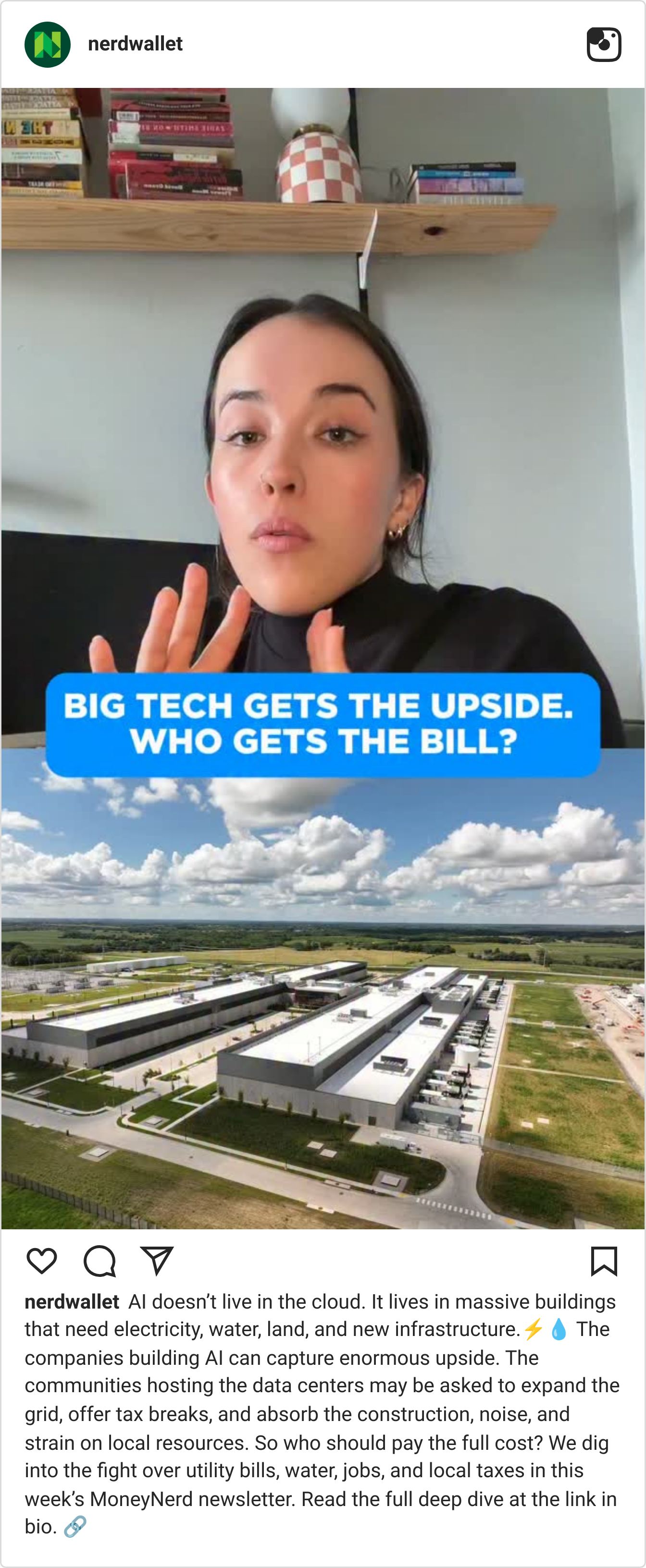
Big tech gets the upside. Who gets the bill?
AI doesn’t live in the cloud. It lives in massive buildings that need electricity, water, land and new infrastructure. The companies building AI can capture enormous upside. The communities hosting the data centers may be asked to expand the grid, offer tax breaks, and absorb the construction, noise, and strain on local resources. So who should pay the full cost? Watch below to find out.
Who killed the party store?

(Photo by Joe Raedle/Getty Images)
- Rick VanderKnyff, senior news editor
I was having a casual conversation with some of my NerdWallet colleagues (on Zoom, of course — we live all over the place), when talk turned to party supplies.
It turns out party supplies matter, especially for parents of young children. And party planning got harder last year when 700 Party City locations blew out their candles all at once.
If you’ve never been to a Party City (which seems improbable, but hey), it was row upon row of all the stuff you need for a kid’s shindig, or for your graduating nephew, or for whatever festive holiday was next on the calendar. Especially Halloween.
Party City first filed for bankruptcy in 2023, emerged for a time, then closed all corporate locations after a second bankruptcy ended in February 2025. About 30 independently owned locations remain around the country, but the national chain is dead. Or, mostly dead (more on that later).
So, who killed the party store? COVID is a likely suspect, given the timing; lockdown was not great for the birthday party business. There was the global helium crisis of 2019. There were changing retail habits and encroachment from big-box stores. And how about the debt load that ultimately triggered the end? It originated back in 2012, with a leveraged buyout.
There’s no one killer, of course. They’re all guilty to one degree or another. But there may be a final twist in this case.
Maybe Party City isn’t dead after all? Somebody call forensics.
The twist: Party City “stores” are opening again — as tenants within most Staples locations (some 700 of them) by the end of this year.
The double twist: It’s an imposter! Kind of? A third company bought the name and is working with Staples on the latest resurrection of the once-ubiquitous brand. Is Party City alive after all? We’ll let the jury decide.
Meanwhile, life goes on and birthdays keep coming. I asked my personal-finance expert teammates for party advice, and here’s my favorite slice, from Pamela de la Fuente:
“For kids' parties, remember that they don't care about anything you care about. Spend as little as you can and don't buy junk for other parents to throw away.”

Smart Money: Older Americans in the workforce
As a record wave of Americans hit age 65, the shape of our workforce is changing. NerdWallet news editor Rick VanderKnyff talks to Gary A. Officer, CEO of CWI Works, about the challenges facing older workers.
Check out the episode below.
Watch or listen on Spotify.
Listen on Apple Podcasts.
Check out more NerdWallet podcasts.
Settle the debate: Would you give a friend money?

- Courtney Neidel, personal finance editor
Pause before you pay off that mortgage. Financial experts recommend asking yourself a series of questions before deciding whether to funnel extra cash to your mortgage payment or your savings.
Utilize travel hacks. One of the best ways to travel smart? Learn from your fellow travelers. Contributing writer Chris Dong explains how he booked a lie-flat seat on a short flight — and how you can too.
Check the price of your summer streaming. Summer heat keeping you indoors? Review your subscriptions to see which ones are worth keeping — and any you can cut. We recently reviewed YouTube TV, Paramount+ and Netflix.
Fewer Americans expect a recession
- Elizabeth Renter, senior economist
The share of Americans expecting a recession in the next 12 months fell to 60% in July, down from 66% just a few months ago, but like much of the economic data we’re seeing right now, this survey was fielded before the ceasefire with Iran fell apart.
This recession question is part of NerdWallet’s Financial Resilience Index, created to measure just how prepared American households are for economic turbulence. While we’ve only been tracking the overall index for a few months, we’ve been asking about recession expectations for almost a year.
In the first days of this month, it appeared as if the conflict with Iran was nearing resolution, a resolution that would mean greater economic stability and the beginning of the end of high gas prices.
Now, the timing of that outcome is far less clear. While the Index revealed 79% of Americans are confident in their ability to pay their bills on time this month, one-third (33%) will have to rely on credit to manage at least some of their expenses.
With the hope of lower gas prices (and a turning point on inflation) dashed, for the time being, households are likely preparing for continued affordability challenges.
In times like these, you can only do so much as individuals, and ending a war is not on the list of things within your control. Bolstering your emergency fund and revisiting your budget, however, are. And while these things can’t change the path of inflation, they can provide both a feeling of greater security and tangible insulation against whatever the economy has in store.

Here’s what else you may have missed this week from NerdWallet:
The latest budgeting method to go viral on TikTok is the 70/20/10 budget. We broke down how it works and how it compares with other budget strategies.
Too much net worth in one stock? We covered how to make a plan for how much company stock makes sense for your portfolio, and what to do with the rest.
What credit score do you need to get a balance transfer credit card? We used real applications to find the answer.
Take a look at our latest small-business loan data. We found most high-revenue business loan applications need money for day-to-day expenses.
A Redditor recently asked how to handle a friend who asks for financial help. We dove into the Reddit debate and asked experts to weigh in.
Elsewhere in money news:
Truth Social is licensing its data to Wall Street. (Axios)
Have you figured out what you’ll do in retirement? (The New York Times) 🔒
Americans are making fewer visits to restaurants with lettuce-heavy menus. (CNN)
Your MoneyNerd team: Courtney Neidel, Anna Helhoski, Rick VanderKnyff.
Was this newsletter forwarded to you? Subscribe here.
See all of NerdWallet’s newsletters here.
Until next week,
