

Anna here. As I said to my editor (hey, Rick) before pitching this, I am fascinated by prediction markets — online platforms where people can bet on future events. It’s not the betting itself that engrosses me, it’s the type of bets you can place — sports, financial markets, elections, awards shows, natural disasters, etcetera. In other words, if you can think of it, there’s probably a market for it.
(If you missed the segment I did on the Smart Money podcast last week exploring the current state of prediction markets, you can check that out on Spotify, Apple Podcasts or YouTube.)
Polymarket was forced out of the U.S. in January 2022 by the Commodity Futures Trading Commission for offering unregulated bets on future events. But Americans didn’t stop trading: One recent analysis by Rutgers University statistician Harry Crane estimates that U.S. users accounted for 19% to 48% of Polymarket's offshore trading volume over the past year — equating to $10.6 billion to $26.7 billion.
The platform made a return to the U.S. late last year to operate as a regulated prediction market (although many of us argue it’s still underregulated). And while it’s blocked in some states, for app users in particular it’s been off to the races ever since. So who is doing the betting?
Pew Research Center released a report in late July about the typical Polymarket user and found that, well, there really is no single typical user. If you boil it down, there are casual users and more compulsive ones — think of it like someone playing a nickel slot versus someone spending hours at the poker table.
Casual users make relatively small bets, roughly $6.50 per trade on average, according to Pew. Most of these users make fewer than 100 trades over a period of six weeks.
Highly active users make hundreds or even thousands of trades — and, unsurprisingly, some are losing significant amounts of money. About 11% of Polymarket users who made at least 1,000 trades lost more than $1,000 over the six-week period.
What are people betting on? Sports, cryptocurrency and politics make up nearly all trading volume. But users can bet on just about anything.
Case in point: Right now there are over 500 active predictions on natural disasters on Polymarket — everything from earthquakes and meteor strikes to hurricanes and drought. Tune in later this month for an article on natural disaster betting.
Until then, here’s what I predict is covered in this week’s MoneyNerd:
How easy is it to leave your job right now?
The surprising financial incentive of giving blood.
The real cost of autism.
The pandemic-era mortgage boom’s lasting impact.
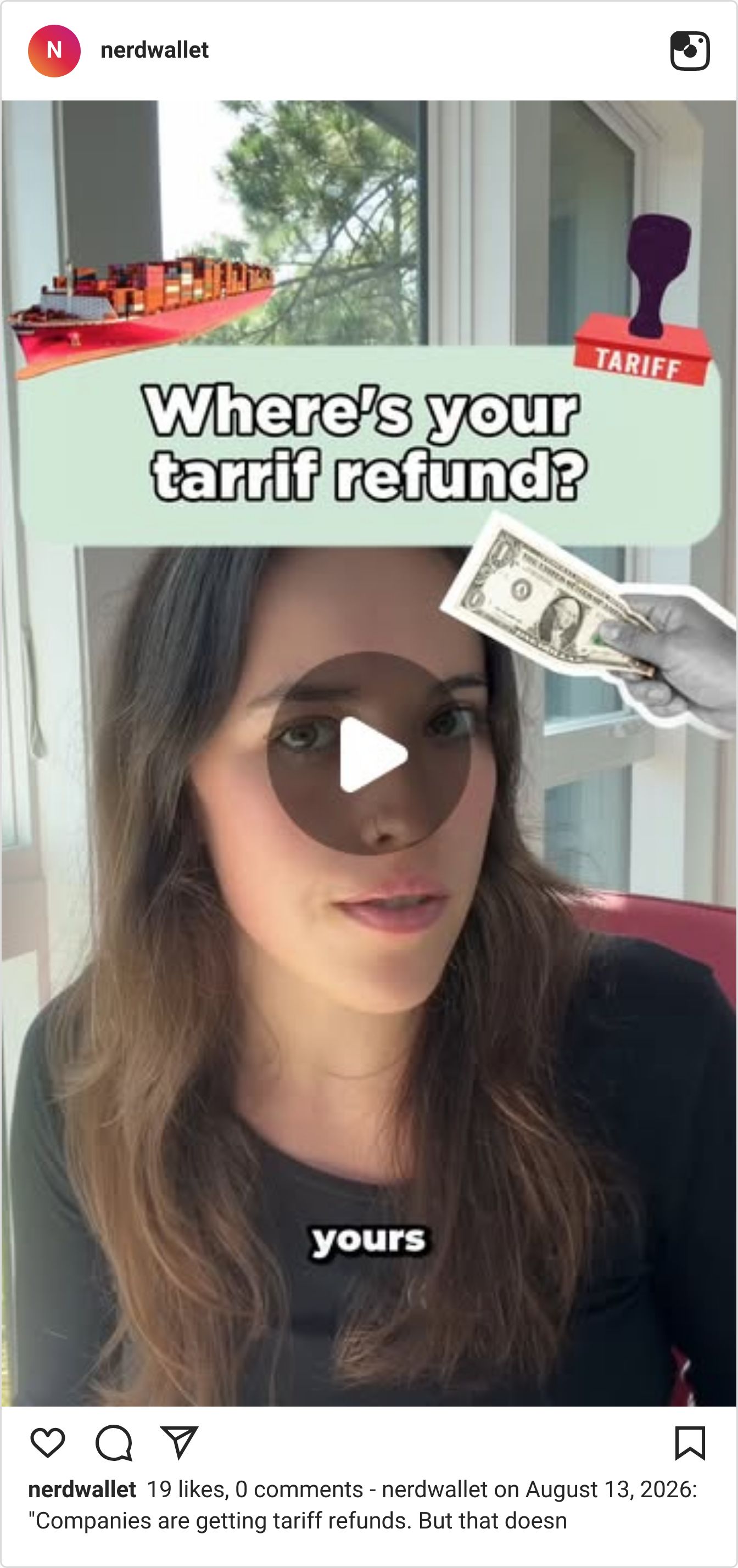
Where’s your tariff refund?
Money tips and more!
Labor market lethargy — what the lag means for workers

Job seekers stand at a recruiting booth at a job fair in Sunrise, Florida. (Joe Raedle/Getty Images)
- Anna Helhoski, senior news writer
I’ve been tracking labor market data for years and if I had to describe the current state, I’d give it a solid “meh.”
It’s not collapsing, but it’s not thriving, either. Hiring has slowed, layoffs remain low and workers are staying put. It’s by no means an easy time to find a job, but the slowdown isn’t hitting every industry equally.
So what should workers make of these trends? I talked with Elizabeth Renter, NerdWallet senior economist, about what the latest data tells us.
AH: How would you describe the current state of the labor market and what's the biggest change you've seen over the past year?
ER: The labor market right now is fairly lethargic. There is a lot of data on the labor market, and taken together it suggests that the economy is adding jobs at a macro level, but not many, and the growth isn’t spread broadly across industries.
I think the biggest change this year is in where we expect the labor market to go next. Toward the end of last year, the unemployment rate was creeping up and job growth was becoming more muted. While these measures haven’t changed dramatically, their trajectory isn’t what it was, so the 2026 labor market is in better shape than I was anticipating.
AH: Are we in a "low-hire, low-fire" labor market right now? And how is that different for workers than a normal slowdown?
ER: Yes, we’re still in a scenario where employers aren’t doing a ton of hiring and they also aren’t laying people off. This is likely due to continued economic uncertainty and higher costs, making it difficult to plan for the future. A normal recession would be characterized by much bigger job losses — the unemployment rate would rise pretty dramatically.
That said, what we have right now isn’t exactly great for workers. Those who find themselves without a job would have a hard time finding one, and those unhappy at their current workplace don’t see many other opportunities on the horizon.
Take your blood to the bank (please)

- Lauren Schwahn, personal finance writer
The American Red Cross has declared a national blood supply crisis, for only the second time in its history. The organization issued an urgent appeal to give blood, as hospital demand has outpaced donations.
So how did we get here? And just how bad is it?
The situation: The Red Cross said blood donations dropped to a four-year summer low in July, driven by extreme heat, poor air quality and rampant foodborne illness (thanks a lot, cyclospora). That’s especially challenging in a season when traumatic injuries tend to rise.
Obviously this isn’t great. But how does it affect medical care, exactly? Blood shortages force hospitals to make difficult decisions about how limited supplies are used in emergencies. Blood is also essential for surgeries, cancer treatments and managing other conditions.
The good news: Many of you are reading this with perfectly good blood coursing through your veins. Maybe I can convince some of you to spare a pint. There’s money involved.
The Red Cross is emailing a $20 Amazon gift card to everyone who donates through Aug. 31. Type O donors get a $10 bonus gift card.
Nonprofit blood services provider Vitalant is giving a $15 e-gift card of choice to donors all month.
Sure, that’s not gonna pay off your mortgage. But it might help you fill up your tank or stretch your grocery budget a little further.
Visit redcrossblood.org to make an appointment. Or, look up donation sites for other organizations near you.
Nobody's talking about the real cost of autism care

- Pamela de la Fuente, personal finance editor
This week, President Trump signed an executive order calling for spacing out childhood vaccines. He links the current vaccination schedule to the rise in autism spectrum disorder.
Hang with me, because this does have a personal finance angle.
I’m not getting into the politics of vaccination. What I care about is my kids. They are both on the spectrum, and I wish more time and resources went into supporting kids like them.
Here’s my personal personal finance angle: My colleague Amanda Barroso wrote about the cost of camps earlier this year. That motivated me to start looking.
My son has low-support needs autism, and I found six camps for him, including one for kids over 10 on the spectrum. I paid more than $2,000 total, and most of those camps were on the cheaper side.
My 8-year-old daughter has higher support needs and most camps can’t accommodate her. Our district offers an extended school year program, but not for the entire summer.
I took a week of paid time off, and I found a day camp I thought could work. I budgeted about $200 for two weeks of part-time care in August. It didn’t work out.
The national average for babysitters is about $23/hour, according to sittercity.com. We have a great sitter we pay $20. She took my daughter to the zoo one day so we could work. Admission and her fee totaled $150. For a day.
That was too much for my budget, so I had to get creative with my work schedule. I’m remote, so I can do that, but it’s tough. I don’t know how other families find — much less afford — summer care for kids with additional needs.
That’s what I’d like people to start talking about. Preferably before next summer.
Thanks for being a subscriber! We have five quick questions, and your answers will help shape where we take MoneyNerd from here.

Homeowners ‘locked in’ by their mortgages
In the news segment of this week's Smart Money podcast, mortgage writers Abby Badach Doyle and Kate Wood join senior news writer Anna Helhoski to talk about how the pandemic mortgage boom is still shaping the housing market.
For the full episode:
Watch or listen on Spotify.
Listen on Apple Podcasts.
Check out more NerdWallet podcasts.

- Lauren Schwahn, personal finance writer
Start a sinking fund for next year's school supplies. Saving a little each month can make these expenses easier to manage. Read more ways to slash back-to-school spending.
Make couponing part of your shopping routine. Digital tools can help you find discounts before checkout. Learn how to use apps, browser extensions and more to maximize savings.
Watch football, for less: Where and how to find NFL games without cable.


Here’s what else you may have missed this week from NerdWallet:
A recent NerdWallet survey conducted online by The Harris Poll explores where millennials get financial information and how they're putting it into practice.
Next year, YouTube will change the rules on what it takes for creators to monetize.
Has your student loan payment gone up? Some former SAVE borrowers are seeing their monthly student loan payments increase. Student loans writer Elin Johnson explores how to reevaluate your budget and repayment plan options.
The forecast for home buyers? Still partly cloudy. See what's driving NerdWallet’s latest Homebuying Climate Index and what it means if you're shopping for a home.
They disappeared a couple of years ago, but good news: Costco has brought back Kirkland chocolate chips.
Elsewhere in money news:
Wealth managers lament: Investors are holding more cash. (Wall Street Journal) 🔒
Gas has never been this expensive in mid-August. (Yahoo Finance)
Though airfare has soared, wealthy flyers keep demand high. (MarketWatch) 🔒
A $1 billion Powerball ticket was sold in Illinois. (Associated Press)
Your MoneyNerd team: Courtney Neidel, Anna Helhoski, Rick VanderKnyff and Lauren Schwahn.
Was this newsletter forwarded to you? Subscribe here.
See all of NerdWallet’s newsletters here.
Until next week,
